

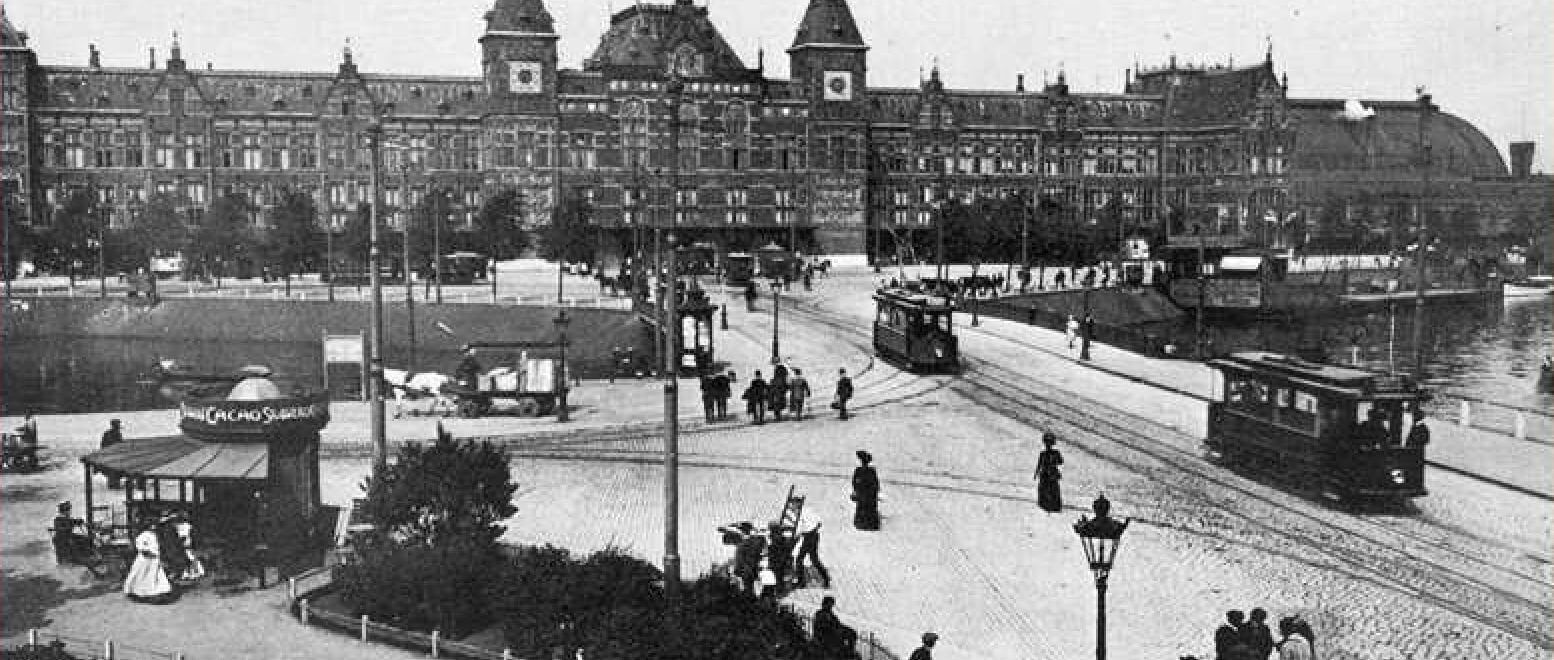
History
On the west side of Amsterdam, trains were leaving from station 'Willemspoort' to Haarlem. On the east side of the city, trains were leaving from station Weesperpoort to Utrecht, Arnhem and Cologne. Also homebase of the Rijnspoorweg traincompany. To set up a coherent rail network in the country, the government introduced the Railways Act. For Amsterdam this meant a connection with Den Helder and the construction of a central passenger and goods station, where the existing and new lines came together. The start of the current Amsterdam Central Station.
1869: The start
The commission was given in 1869. Constructing the station island, station building and railway yard lasted 20 years. Laying the foundations was particularly problematic; 9000 piles were driven to provide a solid base for the building works. Executing the plan meant the city centre was cut off from the IJ waterfront.
The architects P.J.H. Cuypers and A.L. Van Gendt were commissioned to design the station building in 1875. The building is clearly constructed in the style of Cuypers’ other designs, including the Rijksmuseum: classical and richly decorated.
Besides the waiting rooms – with special accommodations for royal and foreign visitors – the station building consisted of offices for the railway staff, a ticket office, dispersed ticket booths and a barber’s.
1889: The Central Station was officially opened October 15th!
1924: The continuation
The eastern wing of the station building was demolished in 1920 for the post-office building, which had been designed by Cuypers’ son (Jos Cuypers). Meanwhile, rail traffic was increasing unabated. This meant new tracks were added, a second cover and a building at the IJ side.
1980s: huge increase
The number of passengers increased enormously. The middle tunnel was widened.
2004: The west tunnel was also widened. Construction was also commenced on the North-South Line under the station. This meant the middle tunnel and the station’s main concourse had to be closed. Work was then started on building the bus platform and a new entrance on the IJ side.
2015: The bus platform on the IJ side was put into use, on top of the IJhal, where restaurants and service shops were now located. Two new passageways were also excavated beneath the station, both gate-free. The IJpassage was opened in that year. The bicycle and pedestrian tunnel was also opened, and taxis were moved from the centre to the IJ side.
2017: New stairs were created from the main concourse providing access to the first floor. The historic corridors there were partially restored, and returned to their original condition. The restored third-class waiting room was given a new purpose.
2019: Construction commenced on a staircase and escalators in the Cuypershal to the metro ticket hall. This will allow passengers a sheltered transfer from train to metro on the city-centre side.